Pocket aces are the best starting hand in Texas Hold'em poker. Kings and queens are strong pairs, and ace-king suited is a strong unpaired hand. Which other starting hands deserve a raise depends on your seat, the players left to act and whether someone has already entered the pot. An opening chart stops applying as soon as the action changes.
The examples here assume a six-handed no-limit Hold'em cash game, no ante, similar stacks of about 100 big blinds, and action folded to you. They are examples you can practice with a deck at home. The deal frequencies and rules were checked November 2026. If you need a refresher on the deal, flop, turn and river, start with the Hold'em rules walkthrough.
The best starting hands in poker by family
Look at the ranks of both cards first, then the suits. AA means two aces. AKs means an ace and a king of the same suit, while AKo means an ace and a king of different suits. The letter T stands for ten, so T9s could be the ten and nine of hearts. A pair never needs a suit suffix because a deck contains only one copy of each rank in each suit.
Hand family | Examples | What to notice before the flop |
|---|---|---|
High pairs | AA, KK, QQ | Already a pair. Still capable of losing to two pair or better. |
Two high cards | AKs, AKo, AQs | Can make a strong top pair. An unpaired hand can miss the board. |
Middle pairs | 99, 88, 77 | An overcard on the flop can make later decisions harder. |
Suited connectors | 98s, 76s | Can make straights or flushes. Often need more cards to get there. |
Weak offsuit hands | K8o, J6o, 72o | Poor kickers or limited ways to improve make many easy folds. |
There's a practical difference between owning a pair and hoping to make one. With queens, a flop of eight, four and two leaves you an overpair. With ace-king on that same board, you still have ace high. Both hands may reasonably enter the pot before the flop. The decisions diverge once the shared cards arrive. The World Poker Federation's Hold'em rules explain how the two private cards and five community cards form the best five-card hand.
Avoid treating any ranking after aces as a fixed order in every situation. A hand can fare well against one random opponent and struggle against a narrow group of raising hands. For example, ace-queen may be ahead of plenty of unselected hands. Against an opponent who would only raise again with aces, kings or ace-king, the question is entirely different. Estimate what the action represents before looking up a number.
Use the opening chart only when the pot is unopened
Count the players who can still raise behind you. At a six-player table the first player to act before the flop faces five people who haven't acted. On the button, once everyone ahead has folded, only the two blinds remain. The button will also act after the blinds on later streets if they stay in. Those are two concrete reasons to consider more hands in that seat.
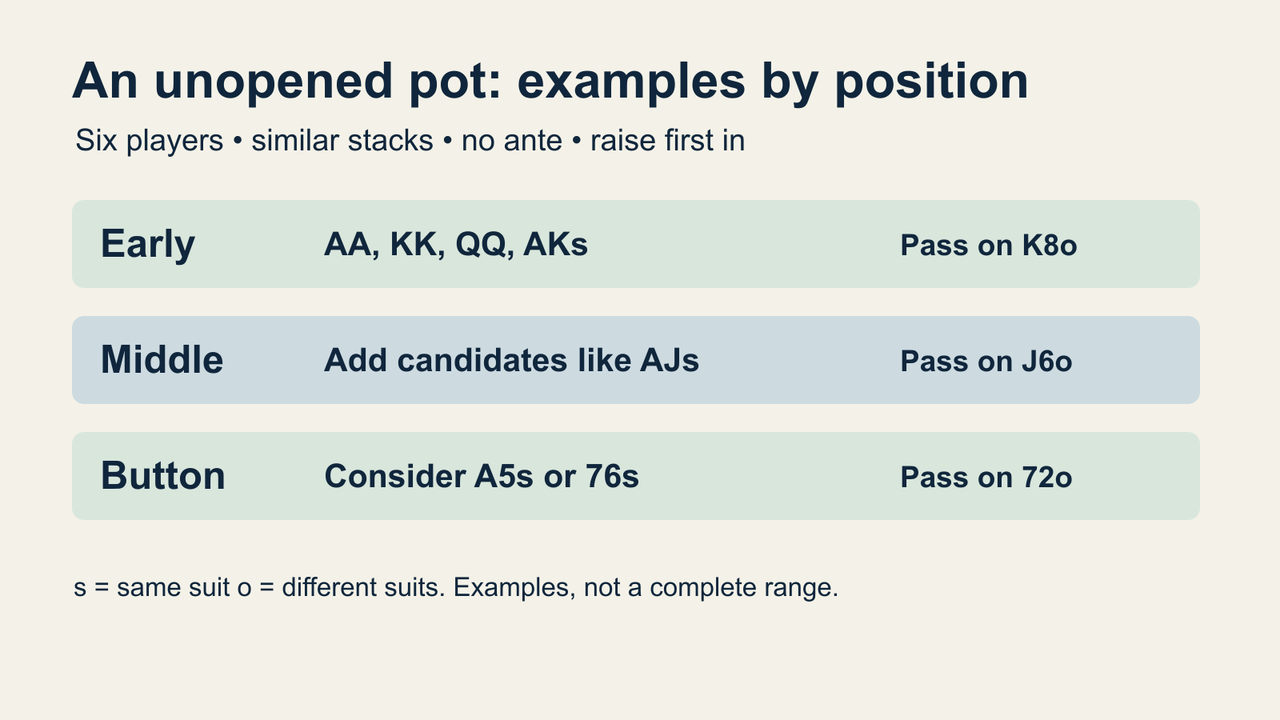
From early position, start with hands that can stand up to action from behind. Aces, kings, queens and ace-king suited are simple examples. From the middle seats you could add a hand such as king-jack suited, depending on who remains. On the button, hands such as ace-five suited and seven-six suited become candidates in a pot everyone else has passed up. For a paper practice session, the table below gives an intentionally tight starting range and two successive sets of additions. Each later column of hands builds on the earlier choices. A plus after a pair includes higher pairs. AK without a suffix includes suited and offsuit versions. These are teaching ranges, not solver results.
When everyone folds to you | One conservative practice range |
|---|---|
First seat, six-handed | Start with 88+, AK and AQs. |
Middle seats | Keep the first group. Add 66, 77, AQo, AJs, ATs, KQs, KJs and QJs. |
Button | Keep both earlier groups. Add 22 through 55, AJo, KQo, A2s through A9s, JTs, T9s, 98s, 87s and 76s. |
Here's a way to use the chart with real cards. Lay out a king of clubs and eight of diamonds in front of the first seat. Five players still have a decision, and a stronger king can make the same top pair with a better kicker. Move those same cards to the button. You now see why folding can be clear in the first seat and why a decision later may depend on the blinds. Moving a hand to a better seat can improve the opportunity without changing the ranks on the cards.
A blind is its own decision. The big blind has already put chips in and can check if nobody raises and the small blind just calls. Checking keeps the hand in at no extra cost. An unopened-pot chart that labels seven-deuce a fold doesn't tell a big blind to surrender a free check.
When somebody raises before you
Set the opening chart aside. An opening raise comes from the first player choosing to put more money in than the forced blind. Facing a raise, your immediate options are to fold, call that price or raise again. The raiser's seat matters, and the players behind you can still change the price. Use a separate response range for that situation if you're studying charts.
Imagine holding ace-jack of different suits on the button. If everyone folded, you would consider raising. If the first player raised and the next player raised again, both have shown interest with players still to act. Even an ace on the flop can leave you facing a difficult decision. Ace-queen and ace-king can make the same pair with a better kicker. The hand that looked inviting when folded to you may be an easy fold facing two raises.
Turn the example around. You hold kings in middle position and face one raise. Kings are one of the strongest starting hands, and raising again is a conventional way to build the pot when weaker hands can continue. Now imagine that all the money in front of each player is only a few big blinds. That changes the later decisions available. A chart drawn for about 100 big blinds can't describe both situations with one colored square.
What poker starting-hand percentages measure
In a 52-card deck there are 1,326 different two-card deals, ignoring the order in which you receive the cards. Multiply 52 choices for the first card by 51 for the second and divide by two because an ace followed by a king and the same king followed by the same ace form the same holding. Group the deals by rank and whether the cards share a suit, and you get 169 types. Aces are one type. Ace-king suited and ace-king offsuit are two more.
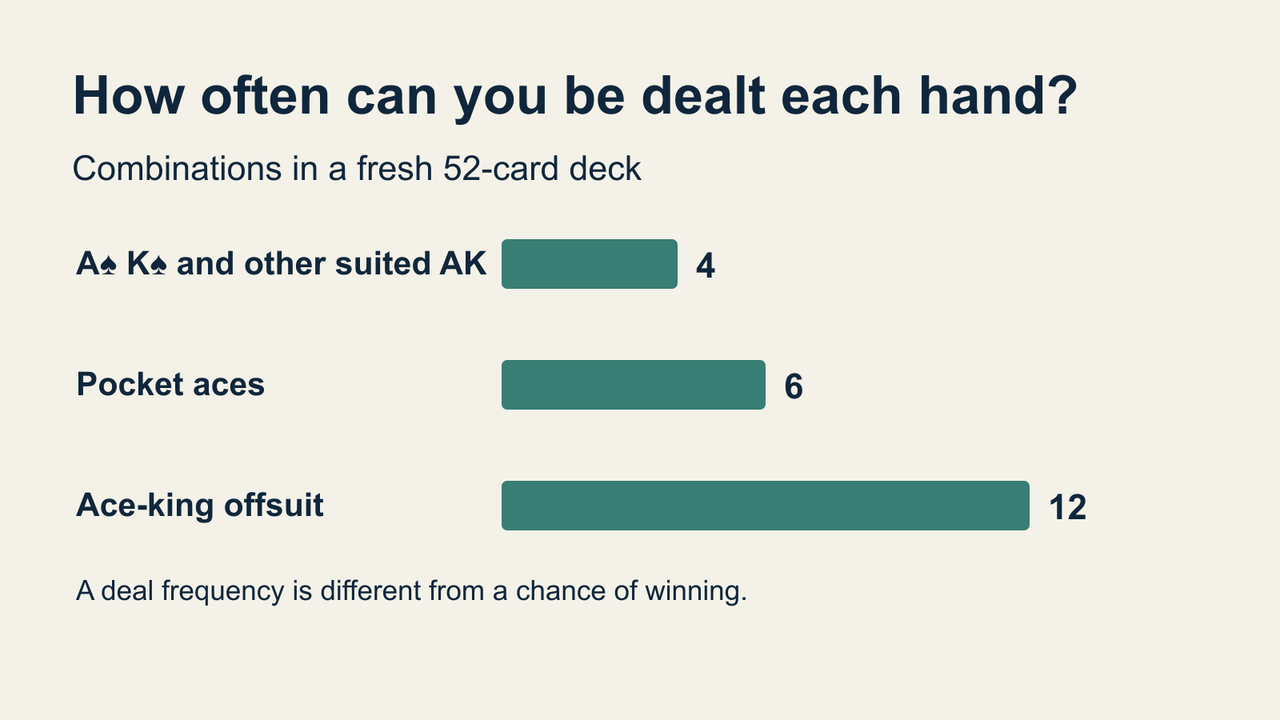
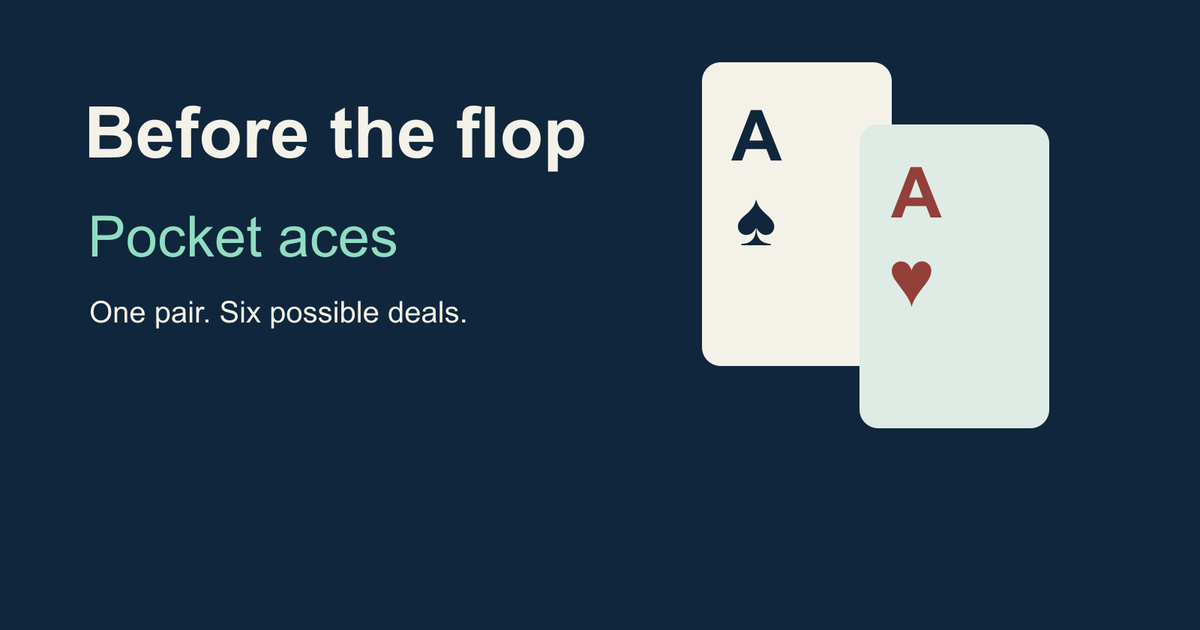
To count pocket aces, choose two of the four aces. That's six combinations out of 1,326, about 0.45%, or once per 221 deals on average. Ace-king suited has four combinations because each suit supplies one matching pair of ranks. Ace-king offsuit has 12, because each of four aces can be paired with three kings of a different suit. The total for all ace-king combinations is 16, about 1.21% of possible deals. Getting no aces over 221 hands doesn't make the next deal more likely to contain them.
Hand frequency is the chance of being dealt a holding. Equity is your expected share of the pot against specified opponents or ranges, including ties, under the conditions being modeled. A third number, an opening frequency, describes how often a person or model takes an action. If a chart says a player opens some percentage of hands, that figure tells you nothing by itself about how often any one of those hands wins at showdown.
Recognize the hands that look better than they play
A king with a low kicker can be expensive to misunderstand. With king-eight offsuit on a king-high board, a player can feel committed because the highest card paired. Against king-queen on a board where both players use their kickers, the eight loses. A second example is ace-two offsuit. Pairing the ace creates the same kicker problem against many aces that called a raise. The extra high card in a stronger starting hand buys you better ways to continue on ordinary boards.
Suitedness helps, but it cannot fix every gap between the ranks. The same suit gives two cards a flush possibility. Cards close in rank also have straight possibilities that widely separated ranks lack. Seven-six suited can use both properties. Jack-three suited can still end up with a flush that loses to a higher flush. The price of seeing the flop, the stacks and how many people are in the pot all affect whether pursuing either hand makes sense.
A small pair brings a different temptation. It is already a made hand, and a third matching rank on the flop would make a set. If someone raises a large part of your available stack, paying just to chase that set may leave little money to win afterward. A hand chart lists the pair as the same two characters whether the stacks are 15 big blinds or 150. The decision around it changes.
Adjust when the table gets shorter
Use the number of players left behind you before using the name of the seat. At a four-player table the first player to act has three people behind. At a six-player table someone opening with three left behind is already farther around the table. A first-position chart for a full table can make a short-handed player pass too many opportunities. Widening doesn't mean playing every suited hand or matching every raise.
Heads-up Hold'em changes the order. The button posts the small blind and acts first before the flop. The other player acts first after the flop. A chart called "button open" for six players can't simply be pasted onto that game. The Poker Tournament Directors Association's heads-up rule sets out the button and blind order. Tournament antes, payout jumps and widely different stack sizes give you further reasons to use format-specific examples.
Keep Omaha and casino poker games separate
In standard four-card Omaha you receive four hole cards and must use exactly two of them with exactly three community cards. An ace of hearts in your hand and four hearts on the board don't give you a flush unless you have a second heart to use. The World Poker Federation's Omaha rules explain the selection requirement. Before choosing a format, the game guides collection can help you find the rules for the game on the screen. The Omaha game guide walks through a deal.
Good four-card starting hands have cards that work together in more than one way. For example, ace of spades, ace of hearts, king of spades and queen of hearts give you high ranks and two suits with pairs of hole cards. Four aces in your hand leave no other ace in the deck and still let you use only two of them. Counting your best two Hold'em cards misses those interactions. Similarly, a house-banked game uses its own payout and decision rules. Our three-card poker guide addresses that different game.
For adults considering paid play, check the local rules and the venue minimum first. A venue that requires players to be 21 or older can refuse a younger player even if a different venue admits them. Try the position exercise with play chips before taking it to a paid table. Decide how much time and entertainment money you're willing to spend first. Our gambling budget guide offers a way to set that amount in advance. For responsible gambling support, the national problem gambling helpline can connect U.S. readers to support.
Frequently asked questions
What is the strongest starting hand in Texas Hold'em?
Pocket aces are strongest before the flop. You can still lose to a hand that improves when the community cards arrive. Treat the ranking as information for a decision before the flop, then reassess your hand against the board and the action.
Is ace-king suited better than pocket queens?
It depends on what you're comparing. Queens start as a made pair, and ace-king suited has two overcards and a flush possibility. A head-to-head matchup, a multiway pot and a decision facing a tight opponent's raise are different questions.
What does the plus sign on a starting-hand chart mean?
For a pocket pair, a plus sign typically includes that pair and every higher pair. For example, TT+ includes tens, jacks, queens, kings and aces. For non-pairs, read the chart author's legend since conventions for expanding the notation can differ.
How often will I get a pair of aces?
There are six ways to deal two aces out of 1,326 possible two-card holdings. That works out to about one deal in 221 on average. It doesn't describe the chance of winning a hand once you've received them.
Can I use the opening chart after another player limps?
A limp means somebody has already entered voluntarily by calling the big blind. The pot is no longer unopened. Consider who entered, who remains to act, how strong your hand is and what a raise or call would accomplish before you commit chips.