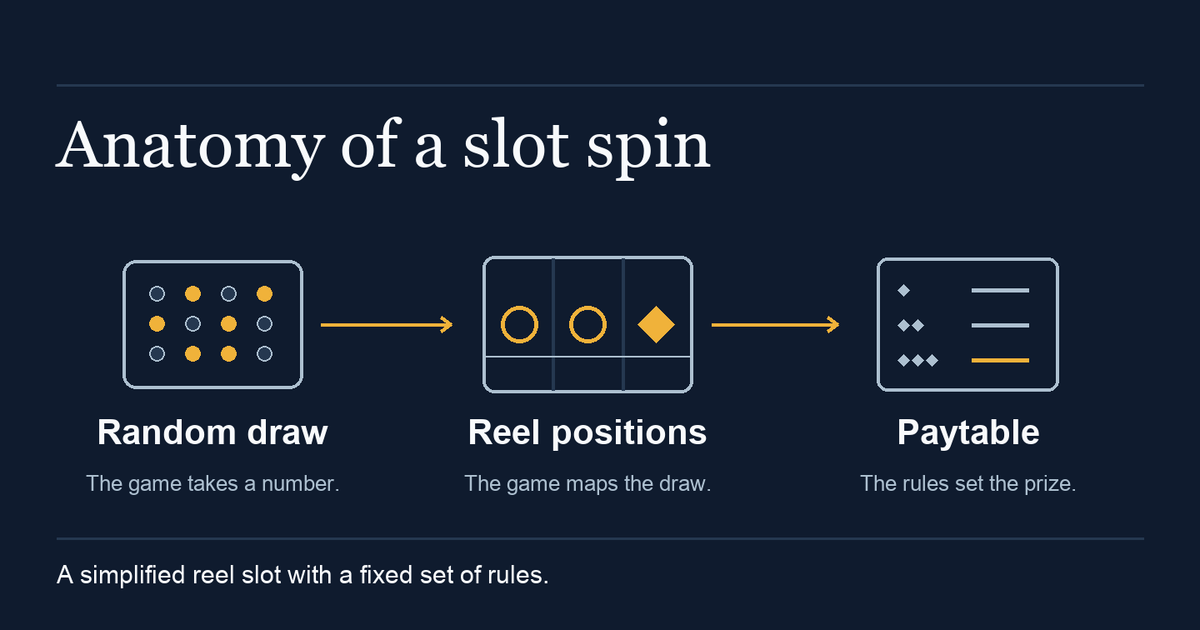
Most modern casino slot machines use a random number generator to select an outcome for each spin. The game's rules translate that outcome into symbols and a payout. Return to player (RTP) tells you the average share of money wagered that the game pays back over time. Volatility tells you how widely individual results can vary around that average.
Take two slots labeled 96% RTP. One could return a small prize on nearly half its spins. The other could go quiet for much longer and pay a larger prize when it hits. Both labels can be accurate. The difference becomes clear once you follow the money through one spin.
How do slot machines work from bet to payout?
A basic reel slot deducts the wager, obtains a random result and applies its paytable. The reel display shows which combination came up. A paytable is the game's list of winning combinations and their awards, sometimes spread across several Help or Info screens.
Term on the screen | The question it answers |
|---|---|
Random number generator (RNG) | How does the game select a result? |
Paytable | Which results pay, and how much at this bet? |
Return to player (RTP) | How much of total wagering returns as prizes? |
Hit frequency | How often does a spin meet the game's definition of a hit? |
Volatility | How far apart are the possible returns, and how likely is each? |
On a reel game, the numbers can correspond to stops on virtual reels. Think of each virtual reel as a list of positions. The computer can select a position even if the cabinet has physical reels that take another moment to settle. In Las Vegas, for example, Nevada technical standard 1.400 requires software RNGs on electronic gaming devices approved before January 2027 to cycle at least 100 times per second on average.
Random selection still allows unequal odds. Imagine an example reel with 20 equally likely stops. A bell appears on four of them and a star appears on one. On that reel the bell has a 4-in-20 chance and the star has a 1-in-20 chance. Knowing that the artwork shows one bell and one star would give you no way to work out which of them lands more often on a single reel, much less the chance of lining up three.
That distinction applies to an online reel game too. Tapping the screen requests a play under the current rules. Watching the last reel slow down tells you how the result is presented. It gives you no timing cue for landing a particular symbol on the next independent spin.
What denominations, paylines and ways mean for one spin
Start with the dollar amount under Total Bet. A denomination tells you the value of one credit. If you play 50 credits at one cent each, a spin costs 50 cents. Keep the same 50-credit selection and switch to a five-cent denomination, and the price becomes $2.50. Both controls deserve a look whenever you change games or settings. Our penny slot guide shows how those controls fit together on a machine.
A payline is a specified path across the reels. Some paths zigzag. Check the line diagram and the direction in which matching symbols must appear. Three matching symbols visible somewhere on the screen can pay zero if they miss every active path. In a ways game, the rules might instead count matching symbols anywhere on qualifying adjacent reels starting from the left. The help screen identifies which reels must participate.
Terms like wild and scatter describe jobs within that particular game. A wild can stand in for other symbols, subject to any exclusions in the rules. A scatter might trigger a feature when enough of it appears across the screen. Read the conditions next to the symbol. A wild that substitutes for a paying symbol can still be ineligible to substitute for a bonus trigger.
One last conversion matters after the reels settle. Suppose your balance starts at $10, the spin costs $1 and the machine awards 40 credits at one cent each. Your new balance is $9.40. A line paid a prize and the spin cost you 60 cents net. You can check that result from the wager and ending balance even if the game celebrates every paying line.
How to read an RTP sheet without misreading your odds
Look for a percentage labeled theoretical return, expected payback or return to player in the rules for the exact game. Check the bet level, the game mode and whether the text includes bonus rounds. A chart of symbol awards is a paytable. Without the probabilities of those awards, you cannot calculate RTP from the listed prizes alone.
Oregon Lottery publishes theoretical payout information for its Video Lottery line games. Its odds and payout guide explains that a range can appear when a larger wager changes certain awards or the return from a bonus. It also directs players to the terminal's main or help screen for the chance of winning any prize. That second figure answers a different question from the payout percentage.
If the rules say the theoretical RTP is 96%, then $100 in total wagers has an expected gross return of $96 and an expected loss of $4. The 4% difference is the theoretical house edge for that setup. No four dollars are set aside when you put in a hundred. A single spin can pay zero or several times the wager, and your return for a whole session can fall on either side of 96%.
The denominator is total wagers. Suppose you start with $20 and make 40 one-dollar spins by playing back credits as they arrive. If those spins return $32 in prizes, your balance ends at $12. Your observed return was $32 divided by $40, or 80%. Your cash loss was $8. Dividing $32 by the initial $20 would count recycled credits as new income.
A regulator can use the same arithmetic across a much larger sample. In its worked RTP example, Britain's Gambling Commission takes a game designed to return 91.68% and calculates an observed return of 90.42% for one month. It evaluates the difference using the number of plays and the game's volatility. A single month's figures and the design figure describe different things, even when both come from reliable records.
Two slots with 96% RTP can pay very differently
Volatility describes how spread out the returns are. A simple pair of made-up games shows why that matters more clearly than a row of lightning bolts on a help screen. Each example costs $1. Imagine drawing one of 100 equally likely tickets for each spin and putting it back, so the probabilities stay the same on the next draw.
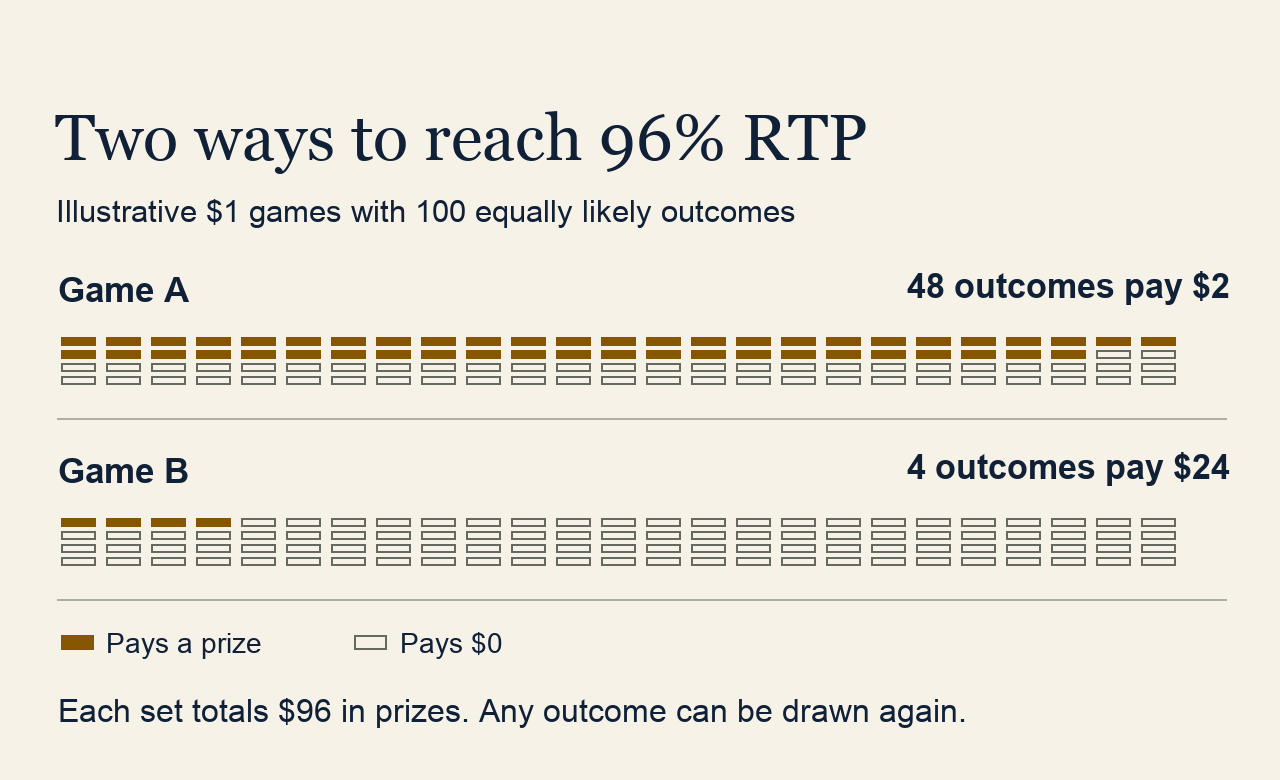
In Game A, 48 tickets pay $2 each and the other 52 pay zero. Add the prizes across the full set of tickets and you get $96. Divide by 100 equally likely results. The expected return for a $1 spin is 96 cents. The chance of getting any prize is 48%.
In Game B, four tickets pay $24 each and the other 96 pay zero. The full set still contains $96 in prizes, so the expected return stays at 96 cents. Here only 4% of draws pay anything. The cash result ranges from a $1 loss to a $23 net gain on one spin. Game B is more volatile.
You never work through the tickets in order. All 100 are available on every draw. Game B could pay twice in succession or miss on every spin of a short session. Two zero results in a row have a probability of 0.96 times 0.96, about 92%, in Game B. The same calculation for Game A gives 0.52 times 0.52, about 27%. Knowing the RTP alone would leave you unable to calculate either probability.
Real slots can have much longer prize lists. A game can record frequent hits worth less than the stake and still put a substantial share of its return into a rare feature. Ask what counts as a hit and whether the game gives a separate frequency for the feature. A quoted frequency such as one in 100 is a probability per eligible play. It does not reserve the hundredth spin for a bonus.
What a near miss or a losing streak tells you
A jackpot symbol landing one position above a payline is a losing result if the rules require the symbol on the line. Its position makes the loss look close. Moving a symbol one position in your imagination changes the picture without changing the prize or the odds on the next independent spin.
Game designers choose the symbols, their placement and how an outcome appears. That alone cannot tell you whether a particular near miss came from the ordinary draw or from a change to the displayed result. The distinction matters. Britain's Gambling Commission, for example, expressly bars substituting one losing result for a different one that looks like a near miss under its remote game standards. That is a British rule. A couple of close calls on a US machine cannot establish how its software works.
The temptation to press again is real. In a simulated slot experiment, participants rated near misses as less pleasant than ordinary misses, yet reported more desire to continue playing after them. The authors describe a response in that experiment. If a close call makes another spin feel more promising, pause. The chance of winning has stayed the same.
A machine someone has just left after a losing run has no debt to its next player. The previous results also give no basis for calling a machine cold after it pays. The qualification is the game state. If a spin triggers five free spins, the feature can have different rules from the base game. Look for an actual condition described in Help. Ordinary losses leave the base game rules in place.
Where casino slots, bingo slots and sweeps slots differ
Type of game | What to look for |
|---|---|
Conventional reel slot | The RNG selects the outcome. The paytable shows what the resulting symbols award. |
Class II electronic bingo | A bingo game determines the prize, which can then be displayed on reels. |
Sweepstakes slot | Check the selected currency. Gold Coins are for play. Sweeps Coins are promotional entries subject to the site’s prize rules. |
On a Class II machine, look for the notice about the underlying game on the player interface. The federal Class II display rule requires that notice even when the machine shows spinning reels.
For a sweepstakes game, the official rules set eligibility and any redemption minimum. No purchase is necessary to enter, and a Gold Coin balance has no cash value. Our sweepstakes currency explainer covers the distinction, and the Chumba Casino review shows how one site's redemption rules work.
Read the game's rules and the site's sweepstakes rules separately. The first tells you how a pattern awards credits in the selected mode. The second tells you what a promotional credit can be used for and who can request a prize. The same artwork appearing in two modes or at two sites is insufficient evidence that both use the same paytable or have the same redemption terms.
What to check before committing money
Use the information screens before you place a bet. Read the total cost in dollars, identify what must happen for a prize to pay, and check which features are included at that price. If all you can find is a maximum win, you know the largest possible award. You still need the chances of the smaller awards and of a zero to work out the return.
Check the rules for your location. Oregon Lottery, for example, sets its Video Lottery age minimum at 21 or older, checked November 2026. Our state gambling guide covers differences across the US. If you choose to play, settle on a time and money limit before starting. Our gambling budget guide includes a worked example.
If you're spending more than you planned or trying to recover a loss, stop the session. For confidential US support with a gambling problem, call or text the National Problem Gambling Helpline at 1-800-MY-RESET.
Slot machine FAQs
Does the time you press spin affect the odds?
The moment of the wager can determine which random result a conventional machine samples. You cannot predict that result from the screen or reproduce it by pressing at a particular rhythm. Each eligible outcome keeps its assigned probability.
Does 96% RTP mean a 96% chance of winning?
A 96% RTP describes the value of prizes across total wagers. The chance of receiving any prize depends on the probabilities in the paytable. In the two $1 examples above, both games return 96% in theory, with hit frequencies of 48% and 4%.
Do higher denominations improve the payout?
A higher denomination increases the cash value of each credit. Whether it also changes the paytable or bonus eligibility depends on the game. Check the rules for the selected bet and recalculate the total in dollars before comparing percentages.
How do bingo slot machines work?
On a Class II electronic bingo machine, a bingo game determines the prize. The spinning symbols can be an entertaining display of that result. Check the notice on the machine and its bingo card or pattern information to see what produced the award.
Can you tell when a slot is about to pay a jackpot?
Past spins do not reveal when an independent random jackpot will hit. A progressive meter shows the current prize. Check the rules for any special trigger or eligibility condition. A larger display by itself tells you neither the odds nor the timing of the next award.