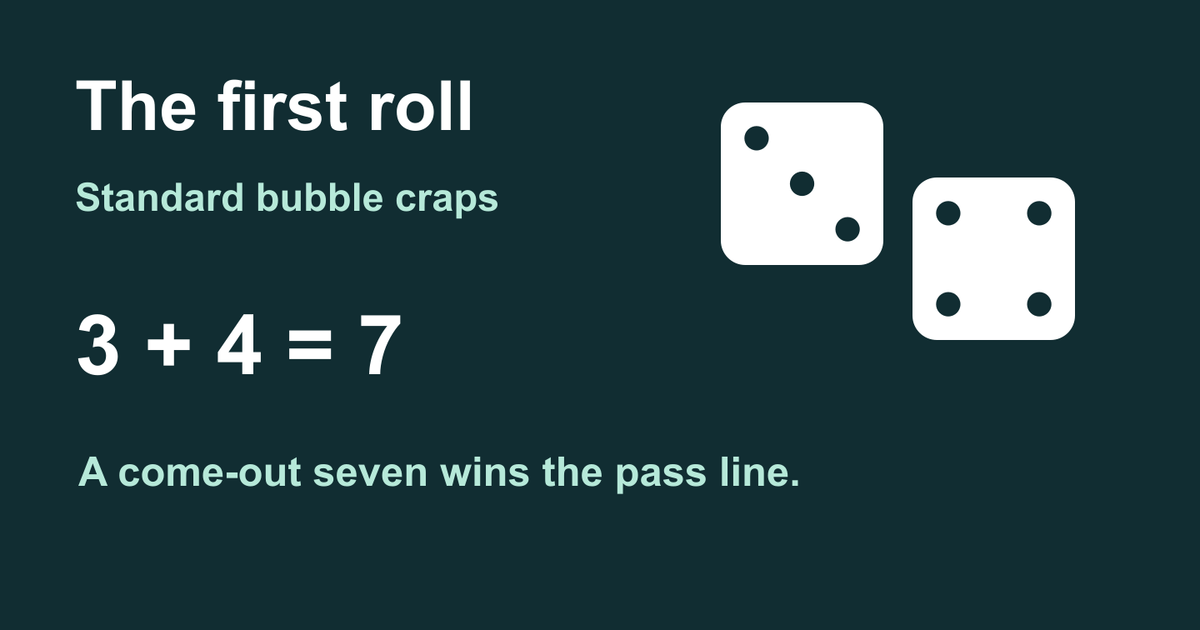
Here is how to play standard bubble craps: select a chip value, put one bet on Pass Line before the come-out roll and watch the total of the two dice. A seven or eleven wins immediately. A two, three or twelve loses. Any other total becomes the point. Your bet then wins if the point repeats before a seven. You can follow a complete round without touching another betting field.
Look up the game name before applying those rules. A machine marked Crapless changes what happens to an eleven. A row of brightly lit numbers above the betting area might be the last several rolls, while the one number marked ON is the point that matters now. This walkthrough follows one $5 example, with an optional second bet shown separately. All dollar amounts are examples.
How to play bubble craps on your first turn
For beginners at a casino, read the game's help screen before putting money in. Check the version, the minimum for the pass line and the value of one credit. Five credits at a dollar each and five credits at twenty-five cents each are different wagers. A chip selector changes what your next tap will add. The amount displayed on the betting field tells you what you have actually placed.
Look for an open betting period and a come-out indicator. On a standard layout the puck usually reads OFF before a new point has been set. Select a denomination and tap Pass Line once. Check the amount on that field and the total wager. Leave the other fields empty. You can learn just as much by observing a round before placing anything.
The physical dice move inside an enclosure on a bubble machine. Depending on the installation, several terminals can show a shared result or a player can have an individual station. Follow the roll prompt on the machine in front of you. A countdown can close betting before the dice settle. Pressing a button to initiate a roll gives no information about which total will appear.
If you arrive while a point is already on, wait through the current decision to follow this example. Touching the numbered box for the current point can create a separate place wager. It does not retroactively buy the pass line bet made before the point appeared. The Interblock terminal manual illustrates the pass field and the lock shown after a point is set.
Follow a $5 ticket through four rolls
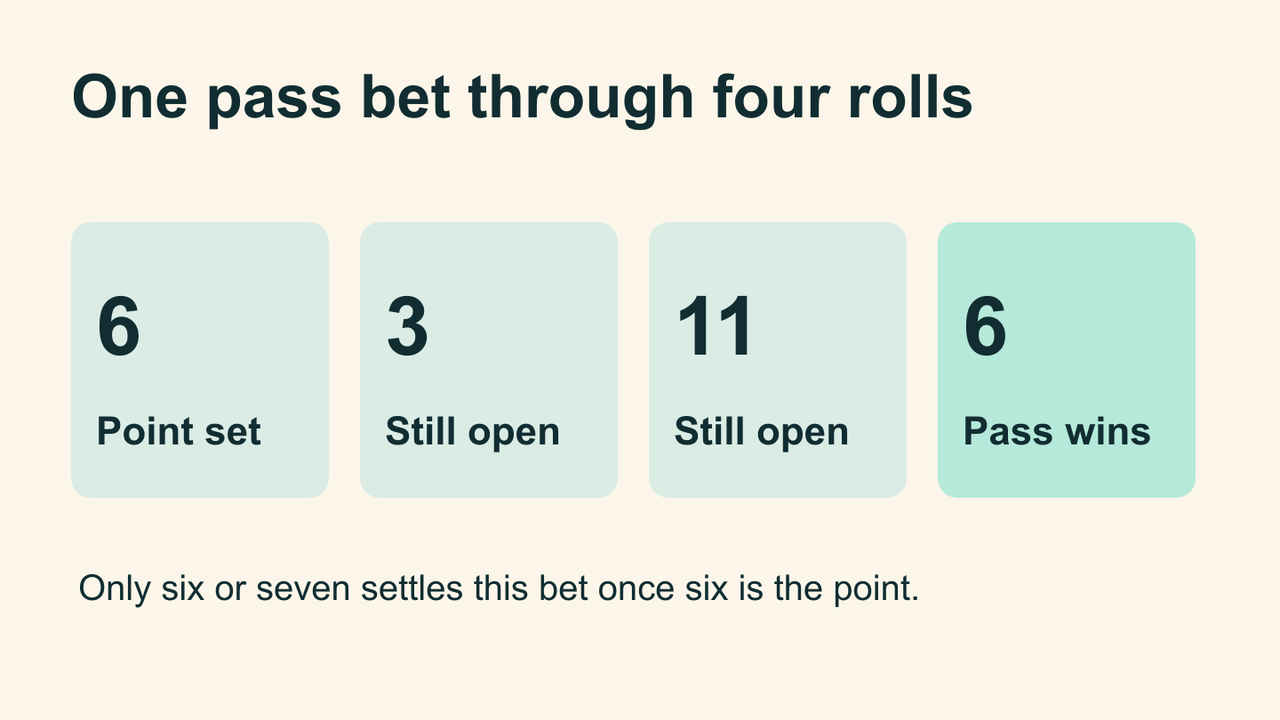
Start with a hypothetical balance of $40 and a $5 pass bet. That commits $5, leaving $35 available if the terminal deducts active stakes from available credit. A come-out six establishes the point. You have won nothing yet. Mark a six on a piece of paper if you want to follow the example away from a machine.
Next comes a three. That would have lost the bet on the opening roll. With six already established, it leaves this pass bet open. A following eleven also leaves it open. The fourth roll is six. The $5 bet wins $5 at even money, and its $5 stake returns. With no other bets and no automatic repeat, total funds are now $45. The amount returned was $10. The profit was $5.
Roll | Total | Effect on this pass line bet |
|---|---|---|
Come-out | 6 | Sets the point at six |
Second | 3 | Bet remains open |
Third | 11 | Bet remains open |
Fourth | 6 | Wins $5 plus the $5 stake back |
Replace only the final six with a seven and the result changes to a $5 loss. The remaining funds would be $35. Replace it with an eight and the bet would still be active. A round can take just one roll or continue for several more. Count decisions separately from rolls when you record what you spent.
The point resets after the pass bet resolves. The next seven can win on a fresh come-out even though the preceding seven ended a round with a loss. The New Jersey game rules distinguish the opening roll from a point decision and list the relevant payouts. Always check the specific rules where you play.
Read an odds bet separately from the pass line
After a point is established, some terminals let you put additional money behind the pass bet in a field called Take Odds. It is optional. You already have a complete wager on the pass line. The extra amount depends on the local limit and the chip increments the terminal accepts. Read both before trying to copy a dollar example.
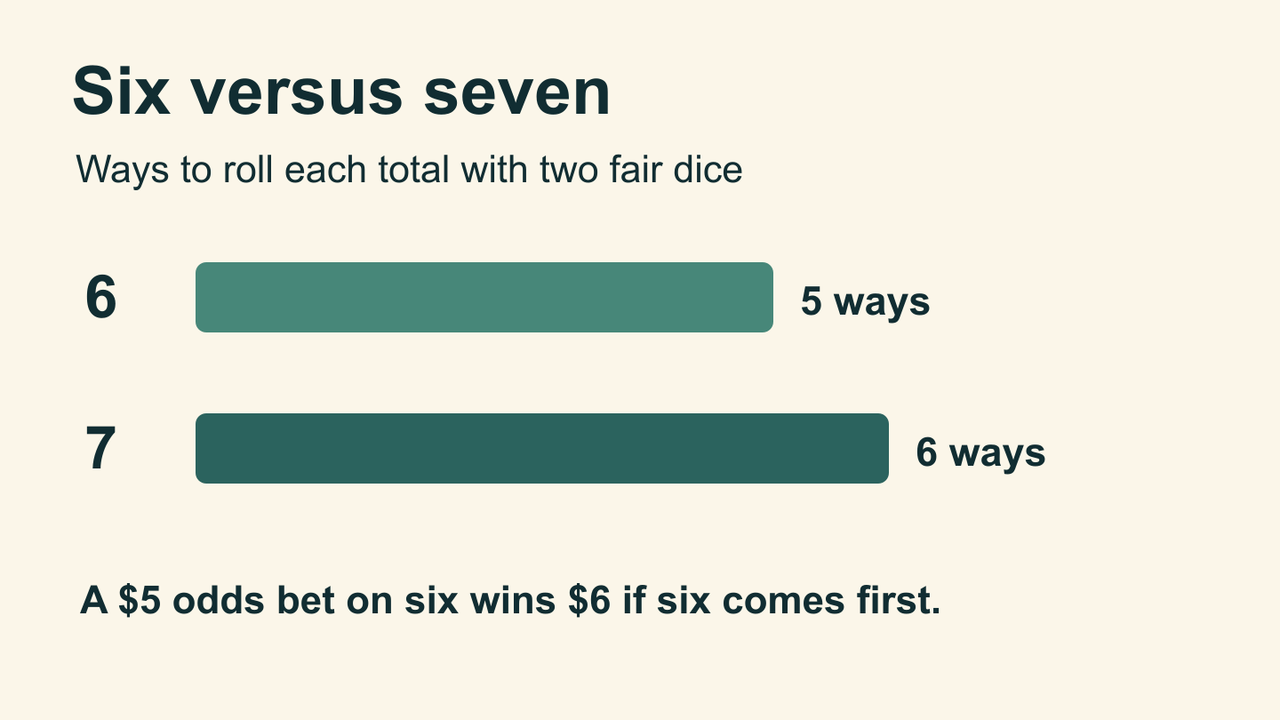
With two fair six-sided dice, there are 36 equally likely ordered pairs. A four can be made three ways and a seven six ways. Once four is the point, totals other than four and seven delay the decision. Among the nine combinations that settle it, three favor the point. A true-odds payout is therefore two units of winnings for each unit of odds staked on four. The original pass bet still pays even money.
Point | Ways to make point | Ways to roll seven | True odds winnings per stake |
|---|---|---|---|
4 or 10 | 3 | 6 | $2 per $1 |
5 or 9 | 4 | 6 | $3 per $2 |
6 or 8 | 5 | 6 | $6 per $5 |
Suppose the point is six and you add $5 in odds to a $5 pass bet. On a six before seven, the first bet wins $5, the odds bet wins $6 and the two $5 stakes return. Total back is $21, including $11 in winnings. On a seven before six, both bets lose and the loss is $10. The published craps payout chart shows the three pairs of point numbers and the corresponding odds.
For comparison, our roulette betting systems guide explains how changing stake sizes changes exposure. True odds describe the payout on that extra wager. They do not assure a win or shrink the amount already at risk. With a $10 spending limit, doubling a $5 position can put the entire limit on a single result. Decide the dollar amount you can lose before looking at the maximum the machine permits. Our gambling budget worksheet guide separates spending limits from a game's payouts.
Spot the difference between standard and crapless
The manual also covers Easy Craps. If that name appears on your machine, open its separate rules before assuming the standard payouts. Find the game title and the pass line rules on the terminal itself. On standard craps the opening seven and eleven both win the pass bet. The opening two, three and twelve lose. On the Interblock crapless version, two, three, eleven and twelve all establish points. Seven is the immediate pass winner. The manufacturer spells out the differences in the Washington-filed variant rules.
Try an opening twelve followed by a seven. Standard play would have settled the pass bet on the twelve, and a newly placed pass bet could win on the following seven. In crapless, the twelve would set the point, and the seven would then beat it. Keep the first stake separate from any hypothetical new one. The machine name changes how many decisions you just watched.
The word crapless can sound reassuring because three immediate losing totals become points. Eleven also changes from an immediate win into a number you must repeat. Twelve has only one combination against six ways to make seven. Giving a bet longer to stay on the layout does not establish that its expected return improved. Read the variant's own payout table for any extra bet you are considering.
Use the screen without stacking unintended wagers
A chip on the six box and a chip behind the pass line can both win when six rolls. They are different bets, with different rules and amounts. A chip on Field can be decided by the very next roll even if your pass bet remains open. Start with one field so that the changes to your balance have a single explanation. After a payout, inspect the layout for stakes still in action before cashing out.
Watch the history strip for practice, but never assign it a predictive value. If the last six totals contained no sevens, there are still six ordered pairs totaling seven among the next roll's 36 possible outcomes with fair independent dice. The display reports completed rolls. For another example of independent events, our slot machine mechanics guide separates a game's recent results from its next outcome.
Terminals and staffed tables can use the same standard pass rule. They can still differ in minimums, maximum odds, how they display unresolved wagers and which side bets they allow. Ask an attendant to identify the denomination and explain how to remove an unconfirmed bet. A posted low minimum refers to a particular wager. Several minimum bets can add up quickly on one screen.
Practice a complete decision without depositing
Use two ordinary dice, or write a sequence of totals on paper, and draw three boxes marked Available, Pass and Odds. Move five pretend dollars from Available to Pass. Call out the point when you set it. Before every following roll, name the two totals that can settle your line. If you cannot identify them, pause and locate the point marker again.
For an online practice screen, choose a clearly labeled free or demonstration mode that requires no payment. Check the variant and read its instructions before treating its behavior as an example of a particular machine. A virtual version can teach the order of decisions without reproducing the pace, physical dice or limits of the installation you will visit.
Rules checked in November 2026. Play only where you meet the local age requirement. For example, Nevada requires casino players to be at least 21 under Nevada gaming law. A responsible gambling limit includes the cash and time you plan to spend. Stop at that limit even if the next round is about to start.
Finish by accounting for all the pretend funds after a win and after a loss. If you later choose to play for money, leave repeat and side bets alone until you can explain every active stake. The game guides collection covers other table games, and our player safety guides cover decisions about money and limits.
Frequently asked questions
What is the minimum bet on a bubble craps machine?
Check the posted pass line minimum and the terminal's credit denomination. There is no single dollar minimum used in this guide. The $5 amount illustrates the arithmetic. A separate odds or side wager adds to the money exposed on the same roll.
Does a seven always lose in bubble craps?
On the standard pass line, seven wins on a come-out roll. After a point has been established, seven before that point loses the pass bet. The point indicator tells you which rule applies when you see the dice.
Can I remove a pass bet after a point is set?
Interblock's standard rules describe an established pass bet as a contract wager and show a lock over its chip. It stays in place until a decision. An optional odds bet is separate, and the terminal's rules govern adjustments.
Do I need to add odds to continue?
No. The original pass line wager can resolve at even money without an extra chip. Taking odds puts more money at risk on the same point-versus-seven decision and gives that extra stake its own payout calculation.
Can a roll button help me predict the next total?
No reliable prediction follows from the timing of a button press or the recent history display. For two fair independent dice, seven has six combinations out of 36 on every roll. Practice identifying the point and the stake instead.