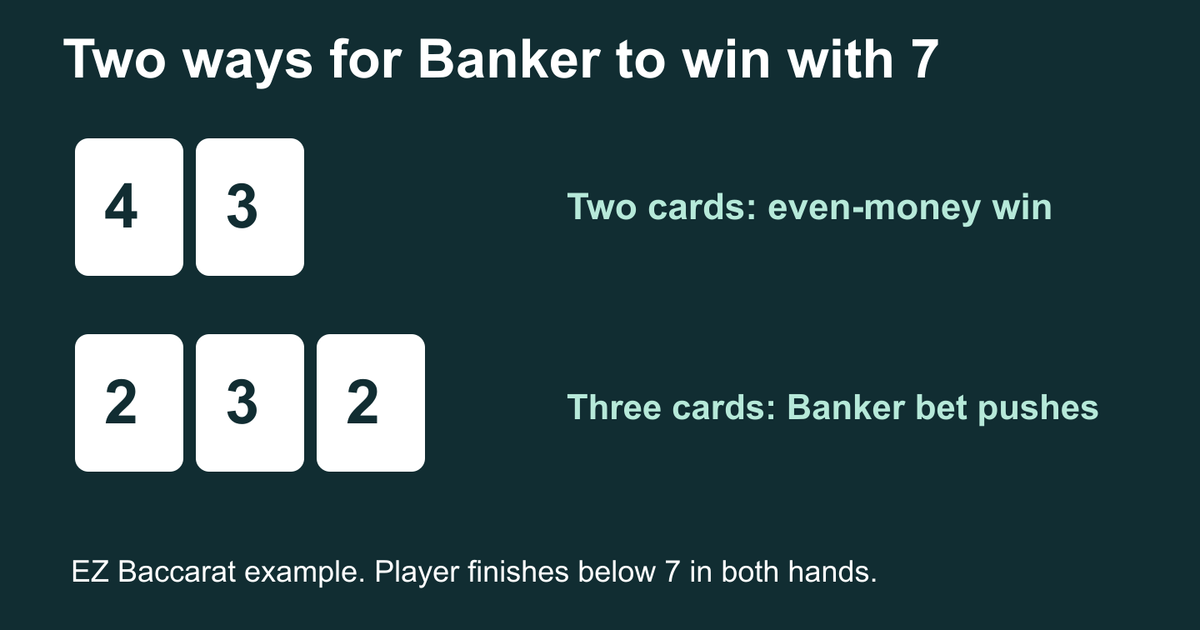
At an EZ Baccarat table, a winning three-card Banker seven returns a Banker bet without paying a profit. Other ordinary Banker wins pay even money under the cited rules. That exception is the first line to find when comparing EZ Baccarat online with a standard commission table. A faster dealer, a multiplier or an animated studio changes a different part of the game.
You can compare four games without wagering by asking what happens to the same displayed $10 bet. How much is taken from the balance before the hand? Which result pays it? Does a special seven return the stake, does a fee apply, or does the game simply give you less time to decide? The examples below use imaginary dollars and rules checked November 2026.
How EZ baccarat online settles a Banker seven
The Nevada Gaming Control Board's EZ Baccarat Progressive rules describe six or eight decks and standard dealing procedures. Player and Banker are the names of the two hands being compared. You can choose either hand. Betting on Player does not give you control over drawing a third card. The dealing rules determine which hands draw.
Suppose Banker finishes with a three-card seven and Player finishes with six. Banker is the higher hand. A $10 Banker wager pushes, so the same $10 returns and the profit is zero. A $10 Player wager loses. The exception does not turn the lower six into a winner. If the Banker seven used only two cards, an ordinary winning Banker bet would earn $10 instead under this schedule.
Change the Player total to seven. Now the two hands tie. Player and Banker main bets push, and a separately placed Tie bet settles at the listed tie payout. Nevada's cited version pays eight to one on Tie. Counting the number of Banker cards matters only after you know which hand actually won. Our baccarat rules walkthrough covers card values and the basic drawing procedure.
Result | Player main bet | Banker main bet |
|---|---|---|
Banker wins with a two-card seven | Loses | Wins at even money |
Banker wins with a three-card seven | Loses | Pushes |
Both hands finish with seven | Pushes | Pushes |
Player eight beats a three-card Banker seven | Wins at even money | Loses |
A Dragon 7 side bet has its own ticket
A qualifying Banker win with three cards totaling seven can also win a separately purchased Dragon 7 wager. That explains a display that seems to celebrate while the main Banker ticket returns exactly the amount placed. The two fields were paying for different events. The congratulatory graphic alone does not tell you which ticket paid or who bought it.
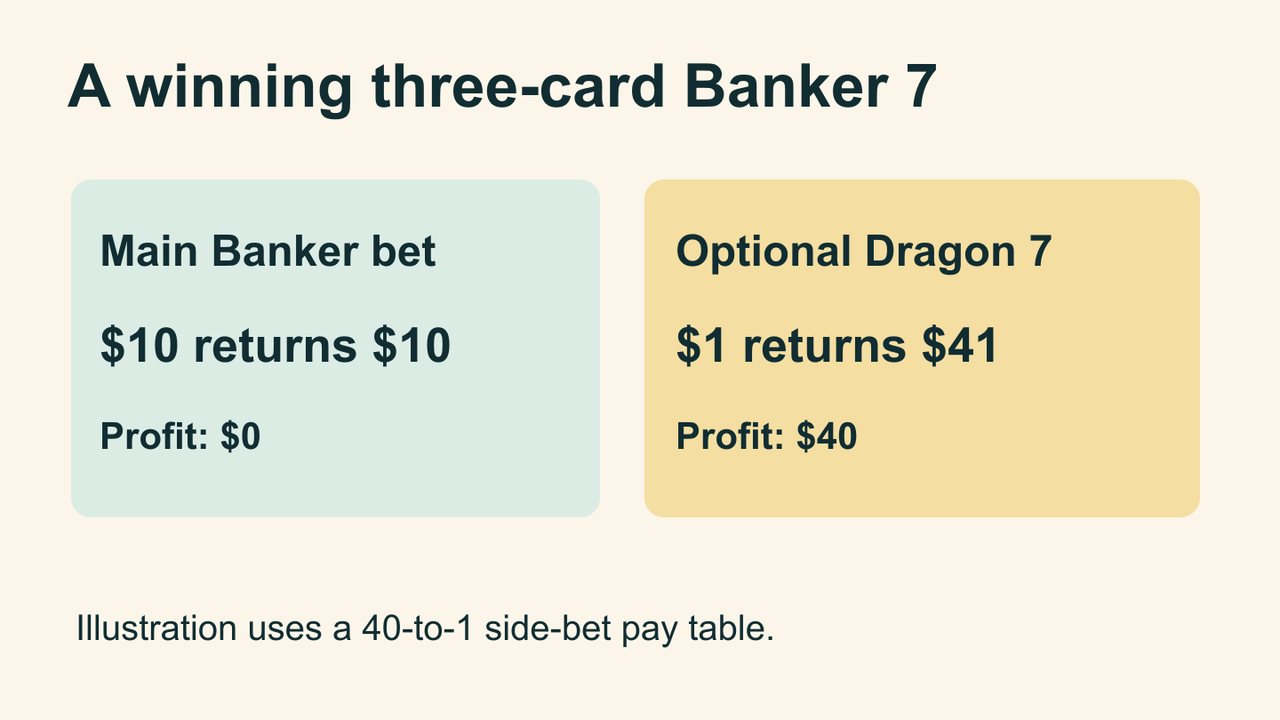
In Wind Creek's published EZ Baccarat guide, the optional Dragon 7 pays forty to one. At that particular schedule a hypothetical $1 side wager wins $40 profit when the qualifying event occurs. A $10 Banker wager alongside it pushes, returning $10. Include the returned $1 side stake before comparing the combined amount returned with the $11 put down. A multiplier at a different table may use a different schedule.
Buying a Dragon 7 on every hand adds a separate possible loss each time the event fails to occur. If Banker wins with a two-card seven, for instance, the main bet wins normally while that side ticket loses. Calling the side bet insurance makes the pairing sound necessary. The ordinary Banker bet already has its settlement rule, and you can understand every result on it without buying another ticket.
Speed baccarat changes the time available
Evolution's live baccarat comparison describes Speed Baccarat as a faster alternative to its conventional live game. The word speed tells you to inspect the countdown. It does not tell you to import the EZ exception, a Golden Card fee or a particular side-bet payout. Check each of those details on the rules screen for the table you actually opened.
Pace changes the amount of action that can fit into a sitting. Imagine watching twelve available hands and choosing a $5 wager on six of them. You have put $30 through the game. Bet on all twelve and turnover doubles to $60, even if your chip value never changes. Those amounts measure total stakes, not net losses. The dealer can run the other hands without your participation.
Speed is a poor match for someone who still needs to look up the winning Banker exception or read the side-bet panel between rounds. Observe two rounds without betting. If the next countdown is already closing while you are still checking the previous settlement, a slower table or a practice game gives you more room to think.
Lightning baccarat adds a fee at the start
Evolution's Lightning Baccarat rules summary specifies a fee equal to 20 percent of the total bet and between one and five randomly chosen Lightning Cards per round. The promotion of a large multiplier is easy to spot. The fee has an immediate effect on your balance even in a round with no qualifying match for your hand.
A displayed $10 wager plus a 20 percent fee commits $12. The $2 is a charge, not a second $2 Banker wager earning the ordinary payout. The selected cards and the winning hand determine whether a multiplier applies. Read the rule for each wager and how the game treats a tie before trying to calculate the final balance. A screenshot showing one multiplied result cannot establish the average cost of the game.
For a fair comparison across online baccarat variants, record the amount removed before the deal, the outcome and the amount returned. A flat $10 comparison misses the extra charge if one version actually debits $12. It also misses the distinction between a returned stake and a profit. Counting both sides of that little ledger makes the next statement easier to interpret.
First Person Golden Wealth uses a different presentation
For First Person Golden Wealth Baccarat, Evolution describes five Golden Cards in a round, each with a randomly assigned multiplier. A winning hand containing a matching Golden Card can qualify for multiplied winnings. The First Person product uses computer-generated play, and its interface can take a user to the live tables. The similar studio appearance does not mean the same dealer is dealing both games.
There is another useful feature for understanding the display: the product lets players deal free hands to build the history or shuffle the shoe to clear it. A run of red or blue marks on the scoreboard describes completed hands. It cannot tell you which Golden Cards will be selected in the next round. No entry on that history strip replaces the current fee and payout panel.
Variant | Read this before interpreting the result |
|---|---|
EZ | Winning Banker three-card seven exception |
Speed | Countdown and the underlying table pay schedule |
Lightning | Fee and qualifying Lightning Cards |
First Person Golden Wealth | Golden Cards and rules in the RNG game |
Pick the rules you can explain before play
For a first lesson, take an ordinary Player or Banker example and work the settlement by hand. Move to a variant once you can say exactly what it changes. Larger wagers bring no extra ability to predict the next hand. A demonstration or a paper example answers the rules question at every budget. If a lobby makes the speed or multiplier clear but hides the fee, leave that comparison unfinished.
This guide is for readers age 21 or older. A published set of Nevada rules identifies a game procedure. Availability of a real-money app depends on the law and licenses where you are playing. Our state directory covers that separate question. Decide on a spending limit before opening the lobby using a gambling budget. If a gambling problem is affecting your finances or wellbeing, call or text 1-800-MY-RESET for confidential help through the National Problem Gambling Helpline.
Frequently asked questions
Does every winning seven push in EZ Baccarat?
Only a winning Banker hand with three cards totaling seven triggers the special Banker push in the cited rules. A two-card winning Banker seven pays the ordinary Banker bet. A tied seven follows the tie rules.
Is the Dragon 7 side wager required?
No. The Dragon 7 has a separate betting field and a separate payout. You can follow the main hand without placing it. A Banker push and an optional side-bet win can occur on the same deal.
What does a 20 percent Lightning fee cost on $5?
Twenty percent of $5 is $1. The hypothetical total commitment is $6 before the deal. Read the payout conditions separately, because the fee does not behave like another dollar on the chosen main hand.
Does a faster table improve the odds?
The shorter betting window alone changes the pace. Look at the dealing and payout rules to compare the odds. Faster rounds also make it possible to place more wagers in the same amount of time.
Is First Person the same as playing with a live dealer?
First Person Golden Wealth is Evolution's computer-generated version. It includes a route to the live games, which are a separate selection. Check which product is open before interpreting its Golden Cards or timing.