To play crapless craps, follow a pass bet from the come-out roll: a seven wins immediately, and every other possible total becomes the point. Once the point is established, rolling it again wins. A seven first loses. The word "crapless" describes the opening roll. It does nothing to prevent a loss on the very next throw.
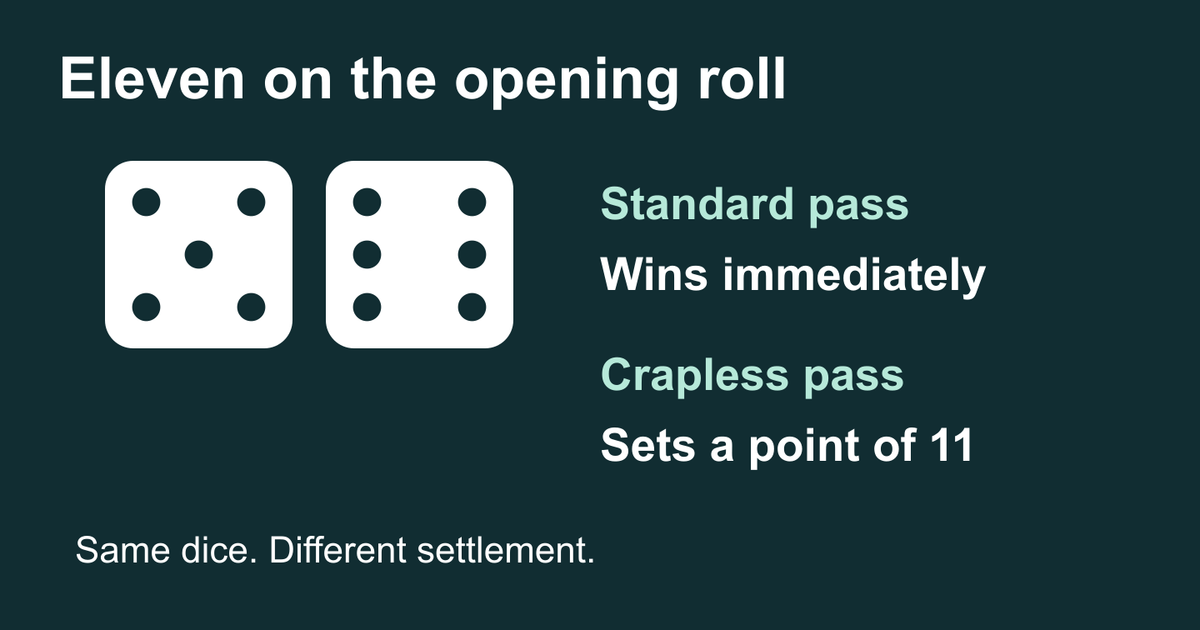
The biggest change is easy to miss on a busy table. On a standard pass line, eleven wins immediately. Here, eleven sends the dice around again with an unfavorable race ahead. Below is a paper example, the payout schedule for a separate odds bet, and the arithmetic behind the higher cost. No deposit or live wager is needed to follow it.
How to play crapless craps from the come-out roll
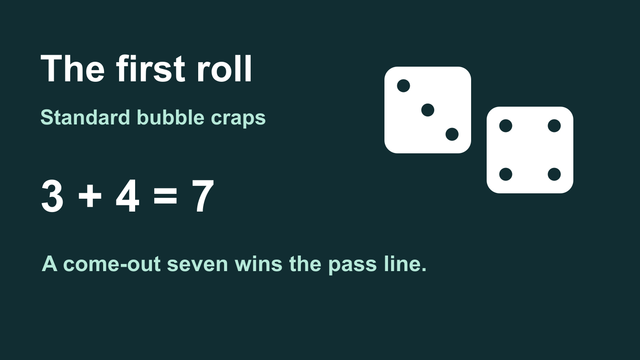
Find the field labeled Pass Line and the marker that shows whether a point is on. The Nevada rules of play give the opening seven an even-money win. If the dice show three and four on that opening throw, a hypothetical $5 pass bet earns $5. The original money returns too, for $10 total in that example.
Change the dice to six and five. The total is eleven. The marker goes on eleven and the original $5 sits there. A four on the following throw does nothing to this pass bet. A subsequent eleven pays $5 profit. A subsequent seven instead loses the original $5. An immediate rematch between the eleven and seven is possible, but the same bet can also sit through many irrelevant totals.
One useful way to follow a crowded layout is to cover every number except the current point and seven on a piece of paper. Uncover the full set again when the decision ends. The change in what counts is the reason someone watching the same dice from the middle of a round can think the opening result has been settled incorrectly.
Roll | Standard pass line | Crapless pass line |
|---|---|---|
Opening 7 | Immediate win | Immediate win |
Opening 11 | Immediate win | Point becomes 11 |
Opening 2, 3 or 12 | Immediate loss | Rolled total becomes the point |
Opening 4, 5, 6, 8, 9 or 10 | Rolled total becomes the point | Rolled total becomes the point |
After point set | Point repeats before 7 to win | Point repeats before 7 to win |
Why losing the opening eleven matters
With two fair six-sided dice, there are 36 equally likely ordered outcomes. Each die can show any of six faces. One and six is different from six and one when counting possibilities. Six of those outcomes total seven, two total eleven, and only one totals twelve. Those counts explain both the attraction of the game and the price charged for it.
Once eleven is the point, ignore all rolls except eleven and seven. Two outcomes now help the pass bettor, while six hurt. Eleven arrives first two times out of eight in the long run. That makes a made point an impressive-looking outcome with only a one-in-four chance from this position. Twelve is tougher: one favorable combination against six for seven, or a one-in-seven chance.
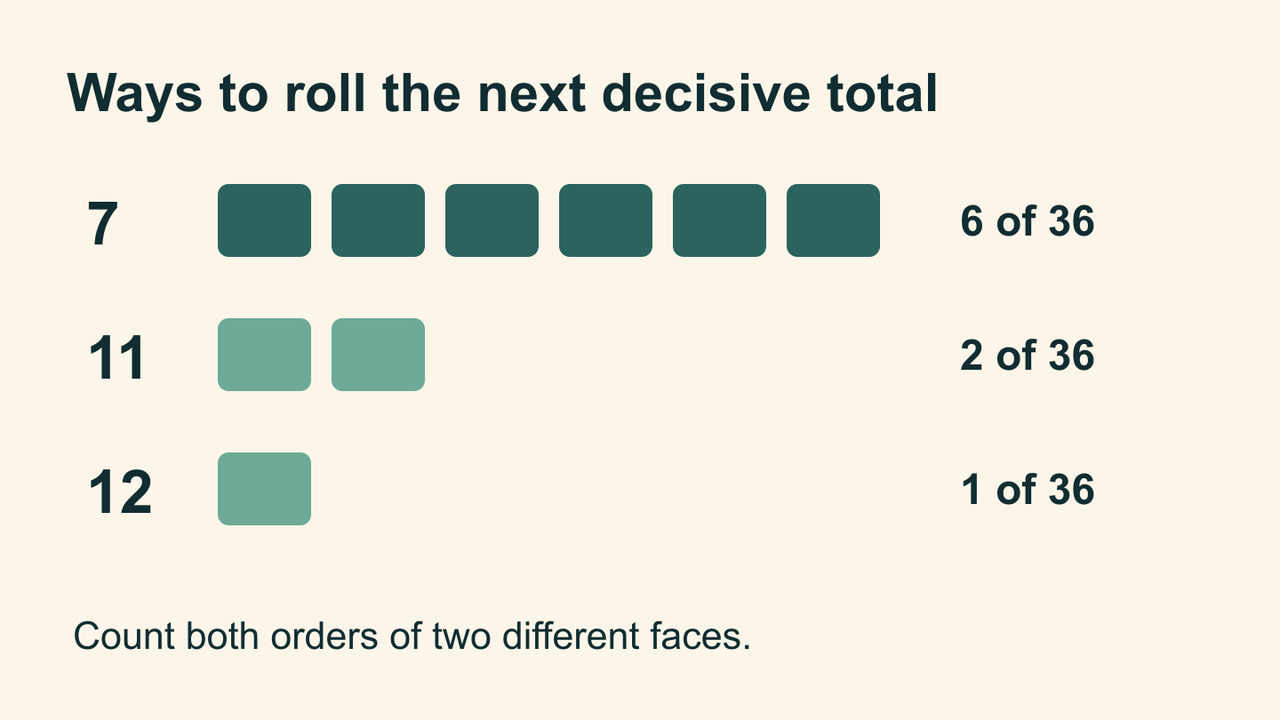
Turn that into a fair comparison by putting the same hypothetical $1 on the pass line in both games. On standard craps an opening eleven pays $1 profit every time. In crapless, the win chance after that eleven is 25 percent and the loss chance is 75 percent. The average net result from that point is a loss of 50 cents. The ability to keep playing on two, three and twelve partly offsets the change. It does not offset the whole thing.
What the house edge measures
To calculate the edge, start with six immediate seven wins out of 36 outcomes. For each possible point, multiply the chance of setting it by the chance of repeating it before seven. A point with five ways to roll it, for instance, contributes 5/36 times 5/11 to the overall win probability. Count both six and eight that way. Add the contributions for the other points using their own counts.
That gives an overall win probability of about 47.31 percent on the flat pass bet. The loss probability is about 52.69 percent. With equal $1 gains and losses, the difference is an average loss near 5.38 cents per dollar initially wagered and resolved. The same calculation with standard come-out rules gives roughly 1.41 cents. These figures assume fair dice, the published rules and no side wagers.
A session does not deliver those averages on schedule. A single $5 pass bet wins $5 or loses $5, with other totals keeping it open along the way. Repeating a losing decision buys another chance under the same rules. For a walkthrough of the standard version side by side with this one, use our standard bubble craps example.
Reading the odds payout table
The flat pass bet pays even money on every winning point. A second wager called odds can pay at a different rate because it backs a point that already exists. The Maryland standard rules distinguish the pass bet from supplemental odds. Read the table or terminal for the permitted amount and any required increments before using the arithmetic below.
Point | Ways to roll it | Profit on true odds | Example odds stake and profit |
|---|---|---|---|
2 or 12 | 1 | 6 to 1 | $5 wins $30 |
3 or 11 | 2 | 3 to 1 | $5 wins $15 |
4 or 10 | 3 | 2 to 1 | $5 wins $10 |
5 or 9 | 4 | 3 to 2 | $10 wins $15 |
6 or 8 | 5 | 6 to 5 | $5 wins $6 |
Suppose twelve is the point on a $5 line wager and you add $5 in odds, assuming the game accepts that amount. Another twelve pays $5 profit on the line and $30 on the odds. Both $5 stakes also return. That is $45 coming back, of which $35 is profit. If seven arrives first, both wagers lose and $10 disappears. Larger odds amounts increase the dollars at risk even though the payout on the odds portion is mathematically fair.
The separate place and buy fields can show different payouts. Pennsylvania's crapless craps rule describes both place bets and optional buy bets with a fee. Putting a chip directly on twelve does not automatically earn the six-to-one odds shown above. Match the name of the field to the name of the payout row before comparing the numbers.
How to play a crapless craps machine
Check the game title and rules first. Bubble describes the physical setup on some electronic games. Crapless describes the treatment of the come-out roll. An enclosure full of moving dice tells you nothing about which version is installed. On a demonstration screen, watch what happens after an opening eleven. A point marker on eleven is the distinguishing feature in this example.
Then check denomination and total stake. A five on the chip selector means something different at five cents per credit than at a dollar per credit. The total wager for the current roll can also include an earlier setting, a repeat selection or an optional side bet. Read each highlighted field. Start a paper record with columns for available credit, unresolved line money and unresolved odds. That prevents a stake still on the layout from being misread as lost money.
The most useful comparison is the plain pass bet on standard and crapless tables. Single-roll proposition bets settle on a different schedule and use their own pay tables. There is no reason to add one to learn the game. People who simply want to see the dice can observe a round, roll two dice at home or use a free demonstration. If the main reason for switching tables is to recover a loss, leave the comparison for another day.
Before choosing a table
Check local age requirements and game authorization. This page is intended for readers age 21 or older and explains published rules, checked November 2026. A manufacturer's game name on an unfamiliar website does not establish that a regulator authorized the site to take a wager in your state. Start with the regulator or our state information directory for the separate availability question.
Decide in advance how much money can be lost, including any odds wager, and leave when that amount is gone. Our gambling budget worksheet helps separate entertainment spending from rent and other obligations. For help with a gambling problem, confidential support is available by calling or texting 1-800-MY-RESET through the National Problem Gambling Helpline.
Frequently asked questions
Can you lose on the first roll in crapless craps?
A flat pass bet made before the come-out roll has no immediate losing total under the cited rules. A seven wins and any other total establishes the point. Other bets on the layout can still lose on that first roll.
What happens if eleven rolls twice?
If the first eleven is the come-out result, it sets the point. An eleven on the next roll completes it and the pass line wins at even money. Two elevens while some other point is already on have a different effect.
What does six to one pay on five dollars?
On true odds behind a point of two or twelve, a winning $5 odds wager earns $30 profit. The $5 odds stake also returns. Calculate the original pass line wager separately because it pays even money.
Is bubble craps always crapless?
No. Bubble machines can use different rules. Read the title and Help screen for the treatment of a come-out eleven, then look for whether two and twelve can become points before interpreting any numbered fields.
Does taking odds remove the pass line disadvantage?
The odds portion pays fair odds when the published schedule is followed. Adding it leaves the expected dollar loss on the original pass bet unchanged and increases the amount you could lose on the decision.